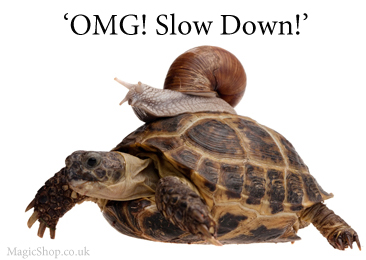
To become the best magician, slow down! Magic is not a race!
We had this email sent in from a customer asking for advice about slowing down his performance:
'I'm a 66-year-old magician and to this day I still rush whenever I'm in front of an audience. It's not as bad as it used to be, but it is still apparent. Any help in this area would be greatly appreciated. Cheers' – Don Podlas
Some advice from Ben Williams:
I know what you are experiencing when you rush a performance! It is a very common problem, just as common as being nervous before a performance. The best magician advice I ever had on the subject was from the late Ali Bongo at my Magic Circle exam was 'just slow down!’. That resonated with me and made me look closer at how I appeared while I performed. I actually thought I was going slow!
If you film yourself practicing routines, the chances are, mostly, that you will not be going too quickly. You may speed up when doing sleights like the shuttle pass, (this should be addressed if it does occur) but in general you will be relaxed as the performance is only to the camera. All of this changes when you are in front of an audience. Fear, adrenaline, guilt, excitement, all of these will play a factor in your performance. Rushing your performance is a common result of these feelings.
Something psychological happens; subconsciously you will want the tough part (usually the most important part) of the routine to be over and done with so that you do not have to worry about it. As a result, we speed up our performance at these times.
Here are a few reasons why people may rush during a performance. Remember if you are mindful of these then you can counteract the urge to rush.
1) Fear of being caught performing a magic trick
Fear is a big one, the main reason probably. Most people speed up when doing the dirty work for fear of being busted. It feels more safe to do things at speed as you think maybe a spectator will not see it. You must remember though that true, deceiving sleight of hand must be natural and we do not naturally do things at lightspeed!
If you look at how you would pick a coin up and naturally and legitimately. You place it in your other hand slowly, you do not rush or do some flamboyant over the top action, you simply put it there at a natural and slow pace. Therefore, when you do this action as a feign or sleight for a vanish, it should look exactly like when you do it normally if you want to deceive people badly. If you were to speed up at the moment when you 'place the coin or item into' your other hand, then it could cause alarm bells to ring in the spectator's mind. Alarm bells are the opposite reaction that you wish to receive!
2) Chasing the reaction to magic tricks
Chasing the reaction is another classic reason for rushing a performance. When you get to the end of a routine, and the reaction doesn't burst out immediately, it can leave you feeling like you have to fill in the gap. So you speak and fill in the gap and move on to the next trick too quickly. You don't 'let the magic breathe'.
Sometimes to speak after an effect can kill the magic entirely, sometimes your audience is just gobsmacked or in awe or just in a moment of pure astonishment so they cannot speak. Let the moment sink in, pause, let the magic breathe and the reactions will come, sometimes it takes a few seconds for the spectators to catch their breath!
Do not rush straight into your next performance. Smile and look around at your spectators, maybe comment if they are silent, you can say something like, 'I take it this is stunned silence!' Mostly that will snap them out of it, and they will let you know how good it was. If it was bad, they would also let you know, but in this case at least you know for sure and can work on what may have gone wrong!
3) Magicians not paying attention to your audience
If you do not pay any attention to your audience or spectators, then you will not notice clues like when they aren't following you.
You must remember, when you have practiced your routine hundreds of times, so you know it inside out, your spectators haven't. It will most likely be the first time they have ever encountered a magician in real life.
Things that may be second nature to you are still very alien to your spectators. If you are rushing your performance, your spectators will do things like go glass eyed and phase out or frown slightly, small reactions to their confused state. If you see any of these signs, you must slow down. You may get a poor reaction because they didn't really understand a part of the routine or part of what you did as the performance was rushed.
A reaction could be poor because they feel that there was something dodgy going on due to fast movements. This way your spectators feel like they are being deceived and not amazed as they are kind of following the trail of dodgy motions and not being sucked into your performance.
Slower is better when performing magic tricks
I hope these things help you to understand a bit as to why you may rush your performance. My advice for slowing down in performance is simple. Breath slower, speak slower and move slower. It may seem like silly advice but when I say this. What I mean by this is to be mindful of how quickly you are speaking and actually focus on speaking slower. Breath in-between sentences, pause for dramatic effect and be clear and enunciate your wording. Also, take deeper breaths, this will slow your heart rate down and help you to relax more. If you slow down your breathing you can use that as a kind of metronome for the rest of your performance, or as a regulator to keep reminding you to slow it down.
We hope this helps not only Don but anyone else who reads this. I can promise you, if you slow down your performance will improve.


Being in a hurry, is a sure sign of cowardice! Usually a true magician is never in a hurry! In any rate, you should always take your time, that is the gutsiest move!
It can take quite a bit of practice to slow down, but well worth the effort. taking your time gives the impression of being ‘at ease’ and that’s a good example to lead by..
Thanks for the comment 🙂
Dominic