How to do Magic Tricks

Advice and Support for Magicians

Famous Magicians – Who Was the Most Revolutionary Magician in History?

by Merchant of Magic 4 Comments

Famous magiciansJamie Kelly (MG Dynamo) asks:

Who are the most revolutionary, famous magicians of all time?

Tweet This

Tough question Jamie! There have been an awful lot of magicians through the ages, each making their own distinctive mark on magic.

We asked other magicians to give their suggestions and as suspected, there wasn’t much agreement.

Here’s a few of the most popular responses 
in no particular order:

Dia Vernon – The Professor.
Suggested by Joshua Bartley. That proved to be a very popular choice. Vernon helped define modern close-up magic and high profile magicians worldwide perform so many of his moves and techniques. The standard cups and balls routine performed today, can be pretty much attributed to Vernon.  His influence on magic has been the subject of complete books, but a good source of information about Dia Vernon can be found here.

Jean Robert Houdin.
Suggested by Connor George. Houdin is probably our choice too. Often regarded as the father of magic as we know it today. We can argue about who is or was the best magician, but pretty much everyone that has followed Houdin is standing on his shoulders.  You can read a detailed article on his history and contribution to magic here.

Harry Houdini.
You can’t question how famous Houdini is, just about everyone in the modern world knows of him. Was he really a magician? He was known to say that he wasn’t a magician himself. It’s true that he performed magic on the stage during his early career, but many reports do suggest he was terrible at it. His fame grew with stunts and escapology capturing the public interest, and his astonishing skills of showmanship and marketing. Here’s more information on the life of Houdini.

Doug Henning. 
Not in the same league as the historical ‘founding fathers’ of magic, but Doug Henning is responsible for moving magic away from the traditional trappings of 1920’s dinner suits. His TV shows in the US heralded a change in magic towards the casual and ‘trendy’. In that sense you could argue it was revolutionary. The Life and works of Doug Henning

David Blaine.
Suggested by Joshua Velez. A popular choice amongst the magicians we asked. Not because of his contribution to methods of magic, but his TV specials really did mark a change in the public perception of magic. The close-up magic tricks he performed were not new or revolutionary, but taking them onto the streets and focusing on the audience rather than the magician was very, very different. It inspired a whole generation of magicians to clone his style, and coined the term street magic. Regardless of whether you think his popularity is due to his talent or that of the format he created for the TV shows. The influence of David Blaine on magic today is profound.
Read about the career of David Blaine here.

Dynamo – Magician Impossible.
Suggested by Steven Holt as a joke. We think votes for Dynamo – Magician Impossible have more to do with his current high profile in UK media at the moment, than his contribution to magic as a revolutionary figure. You could argue that Dynamo has or is leading a revolution at the moment in the UK magic scene, away from stage magic, practical jokes and game shows. His shows present a magician as a real individual with a back story. A kid growing up in a deprived area, using magic to fit in socially. This is a strong contrast to other magicians, who present themselves as ‘different’ and mysterious. The magician as the boy next door is a new concept. He may be inspiring the current generation to rediscover magic, but not many magicians feel there is anything new being brought to the table other than increased viewing figures for magic on television. His magic is great and his presentation of the magician a real person is very positive for magic. His popularity has contributed to an increase in the use of magicians for high profile events in the UK.

Here’s who people are suggesting on the MoM Facebook page:
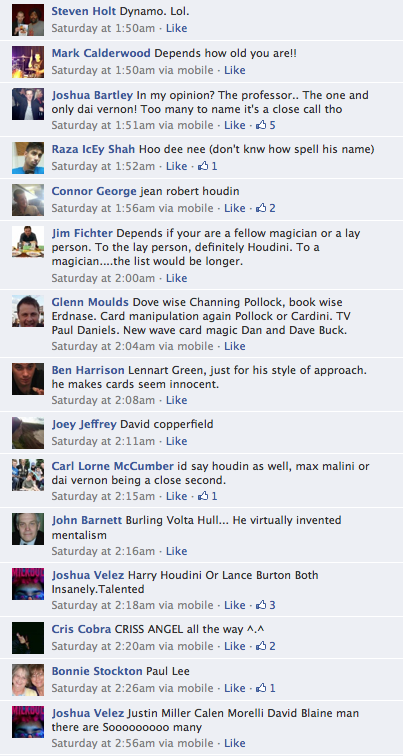
Famous Magicians - Merchant of Magic Facebook Discussion
Who is the most revolutionary magcian?
famous magicians - How do you vote for?

Who do you think should be regarded as the most revolutionary famous magician in history? Tell us who and why in the comments section below:


  • 6 Free Magic Tricks From Jay Sankey
  • Anniversary Waltz Free Magic Download
  • Approaching Magic Practice Ebook
  • Approaching Tables Ebook
  • Recommended For Magic Beginners
  • Cagey Tutorial
  • Choose Magic Set Kids
  • Cloud of Smoke Free Ebook
  • Double Lift Project Free Download
  • Duplex Free Magic Download
  • Epoch Free Magic Tutorials
  • Electric Touch Free Ebook
  • False Shuffles and Cuts Magic Download
  • Faster Than Light - Magic Download
  • Finger-Exercises
  • How to Break In Playing Cards
  • How to Learn Magic Tricks
  • Tips for Leaving a Magic Gigi
  • LSQ Ebook - Free
  • Magicians Fees Ebook
  • Mistakes in Magic Ebook
  • More Icandy
  • The One Minute Magic Business Ebook
  • Pitfalls Magic Family and Friends
  • Safe - Free Magic Ebook
  • School of Cool Free Download
  • Sleight of Hand Beginners Course
  • Split Free Magic Video Download
  • Self Working Card Tricks Vol 2 Download
  • Sweet 360 Free Magic Download
  • The 80's Called Download
  • Self Working Card Tricks Vol 3
  • Think Tank Free Magic Download
  • Turnover Pass Free Download
  • Self Working Card Tricks Download
  • Understanding Misdirection Free Ebook
  • Watch It Free Ebook
  • Wedding Exhibition Guide for Magicians
  • Confidence For Magicians
  • The Indian Shuffle

Filed Under: how to do magic tricks Tagged With: Famous magicians, Magic history, Magic Theory

How is the Dynamo Phone in Bottle Trick Culturally Significant?

by Merchant of Magic Leave a Comment

How Dynamo does the phone in bottle trick

By Dominic Reyes

I was recently interviewed about how:

 Secular magic maintains cultural significance through technology and contemporary modes of thinking. 
It’s an interesting topic, and one that I’m sure every magician contemplates before each and every practice session.

However, it relates very well to what we can learn from the dynamo phone in bottle trick. Here’s an excerpt from the interview:

Would you say tricks that involve contemporary technologies and thinking such as mobile phones have become more popular than other traditional forms of close magic?

Dominic Reyes: Although contemporary technologies have grown in popularity over the last few years, it’s still a very small niche within magic. Their main use still tends to be in the field of mentalism as that is often more information and communication focused. Sleight of hand still retains it’s core importance in most magicians acts.

However, in recent years, tricks with spectators mobile phones have become popular with ‘street magicians’ spurred on by the magic tricks of TV magicians such as Dynamo. The dominant market for tech items remains the high end working professionals that will order specific equipment for a trick. The tech is not explicit, but used as part of the method rather than a presentation or story telling tool.

Would you say their appeal is down to their ability to culturally engage with current modes of thinking in society?

Dominic Reyes: To some extend, yes. The performance of magic, or rather the good performance of magic is just as much about connecting with people as the tricks themselves. The method used is second to the effect produced and observed by the spectators. Technology gives a performer a short cut in the method, but does not help with the social element of the performance. The interaction with the spectator, the emotional context of the trick or how the spectator relates to the impossible events that are presented to them.
Within a magic trick, there are two levels of action occurring. The evident actions (The magic the spectator see’s) and the non evident actions (The secret method of the trick). Current technology is mainly used in the non evident actions of the trick, and as such, is kept secret from the spectators.

An exception to this, are tricks that use a spectators own devices. Twisting a spectators mobile phone or transforming it into another object. The device tends to be used as an object for transformation. In that sense, the magician aims to culturally engage the spectator by using an everyday object of importance to that person. It’s interesting to note that using a spectators smart phone is VERY engaging. This may suggest that the item is regarded by them as an extension of their identity.

There are some tricks that directly use the spectators device, such as making a card value appear on the screen or being able to mind read their lock pin. However, data from The Merchant of Magic suggests they are most popular with magic hobbyists rather than working professionals. Possibly this may be due to the growing understanding within spectators of the possibilities to manipulate these devices. Magicians often disregard tricks like that, as they tend to subconsciously infer the magical abilities are coming from the device rather than the magician.


In a world now increasingly mediated through the machine – our phones, the Internet etc. To what extent would you say that tricks that involve such technologies aim to play with our hopes, dreams and fears of these devices?

Dominic Reyes: People understand that tech can be manipulated and this knowledge will increase over time. A greater value for a magician is in the perceived value of the item to the owner, their reliance on it and its use as a form of communication with their social group. The most popular tricks will involve playing with those feelings, by vanishing or transforming the item that has a personal meaning to the spectator.

A good example of this is the most famous TV dynamo phone in bottle trick – Dynamo – Magician Impossible putting  a borrowed phone inside a bottle. The trick is psychologically powerful.  You have transformation into an impossible object as the dominant visual effect, but there is another context and meaning being expressed. The phone and by implication, the spectators contact with their social group, is removed from them, locked inside a glass bottle. Its use has been restricted by the magician using magic. Locking another persons phone in a glass bottle, could also communicate the fear of being removed from your place in society and your social group. Social exclusion a primary fear for humans, and although only expressed on a subconscious level, it’s a powerful psychological force. Dynamo increased this feeling (on purpose) during the presentation, but causing the phone to ring. The phone calls out to be answered, but the owner is powerless to answer the call. That conditioned response to your phone ringing heightens the effect. Viewers can identify with that feeling expressed in the dynamo phone in bottle trick on a subconscious level. Magic tricks that take a primal fear or desire, and manipulate it, get great reactions. Magicians can use this knowledge in many of the tricks they have already performed. A tweak to the presentation, can dramatically change the impact of the trick.

You could also argue that smart phones, can be used as a social aid for a performer. A popular trend at the moment is for close-up magicians to ask spectators to pull out their phones and video the magic he or she is showing. This often gets posted to YouTube and is great publicity for the magician. In this way the magician is using the social power of the device and the spectators social network.


Do you think tricks that involve cutting edge technology that suspend belief and unsettle ones general understanding of the real help society define an understanding of the boundaries of the reality?

Dominic Reyes: There are many sources for this in popular culture. Since the stone age, man has used storytelling to challenge what people believe to be the boundaries of reality. Technology is really just another word for tools that are new. The cave men had their own technology, in the form of 2 dimensional drawings and the use of pigments in cave paintings. The latest tech became the written word, now we use film and video. It’s all group communication, wrapped up in the trappings of the times. Magic is simply another form of story telling. Just like the special effects of a movie or a theatre play, but presented as reality. I think by the time people watch a magic performance, they have already been socialized in many respects. TV and bedtime stories have already tackled that role during childhood development.

However, it may be interesting to research studies performed on first contact tribes in Africa, and their experiences with photography and radios. There are some very interesting results..


What do you think the future holds for magic and magicians particularly in relation to how they might adapt to create tricks that reflect this change in society? Whats next after mobile phone tricks?

Dominic Reyes: In magic, the same tricks repeat over and over again through the centuries, the props used to dress them up change and adapt, but the magic remains constant. Magicians will simply adapt the same effects to suit the objects their spectators find commonplace yet value greatly.

The dynamo phone in bottle trick will soon become obsolete. I would say that mobile phones already have their writing on the wall. As we move towards technologies such AR and VR, the concept of a personal phone as a distinct object, will be regarded as historical. Technology is always becoming smaller and smaller, and as it does this, it seems to be moving closer to the skin. One reason for this, is the slow merge of function away from individual devices.

My watch, camera, PDA, walkman and phone all become one item. The goal seems to be to reduce the need to switch attention between multiple devices as much as possible. The natural progression of this is, in my opinion, moving access to data directly to the eye. Google glass may only be a transition device, but I think a technology like it, will be the next step and presents magicians with a great opportunity. Augmented reality = controllable perception, a magicians dream come true!

In magic, the same tricks repeat over and over again through the centuries, the props used to dress them up change and adapt, but the magic remains constant. Magicians will simply adapt the same effects to suit the objects their spectators value and find commonplace.

Tweet This

  • 6 Free Magic Tricks From Jay Sankey
  • Anniversary Waltz Free Magic Download
  • Approaching Magic Practice Ebook
  • Approaching Tables Ebook
  • Recommended For Magic Beginners
  • Cagey Tutorial
  • Choose Magic Set Kids
  • Cloud of Smoke Free Ebook
  • Double Lift Project Free Download
  • Duplex Free Magic Download
  • Epoch Free Magic Tutorials
  • Electric Touch Free Ebook
  • False Shuffles and Cuts Magic Download
  • Faster Than Light - Magic Download
  • Finger-Exercises
  • How to Break In Playing Cards
  • How to Learn Magic Tricks
  • Tips for Leaving a Magic Gigi
  • LSQ Ebook - Free
  • Magicians Fees Ebook
  • Mistakes in Magic Ebook
  • More Icandy
  • The One Minute Magic Business Ebook
  • Pitfalls Magic Family and Friends
  • Safe - Free Magic Ebook
  • School of Cool Free Download
  • Sleight of Hand Beginners Course
  • Split Free Magic Video Download
  • Self Working Card Tricks Vol 2 Download
  • Sweet 360 Free Magic Download
  • The 80's Called Download
  • Self Working Card Tricks Vol 3
  • Think Tank Free Magic Download
  • Turnover Pass Free Download
  • Self Working Card Tricks Download
  • Understanding Misdirection Free Ebook
  • Watch It Free Ebook
  • Wedding Exhibition Guide for Magicians
  • Confidence For Magicians
  • The Indian Shuffle

Filed Under: how to do magic tricks Tagged With: Dynamo, Magic Theory, presentation, Psychology, showmanship

  • « Previous Page
  • 1
  • 2
Pick some magic goals for this year we'll help you reach them!

Answer a few simple questions, and we'll show you what we think you should learn next.

SEARCH THE BLOG

GET A FREE MAGIC TRICK


GET A FREE MAGIC TRICK

Download your free magic trick FINK courtesy of Ben Harris.

Fink is an interesting effect: a crazy concoction of Luke Dancy's GRAB, Ben Harris's Through the universe backwards, and Fandango. Created by Kyle MacNeill

BEGINNERS START HERE

BEGINNER MAGIC SECTION

LISTEN TO THE PODCAST

LISTEN TO THE PODCAST
Read Our Privacy Policy

RECENT POSTS

  • Best Stage Mentalism with Playing Cards
  • 15 Easy Magic Tricks for Grandparents to Amaze the Grandkids
  • Too Old to Learn Sleight of Hand? Why 48 (and Beyond) Is the Perfect Age to Start
  • How Often Should a Magician Replace Playing Cards?
  • How to Use a Svengali Deck for Multiple Tricks Without Raising Suspicion

FIND US ON FACEBOOK

FOLLOW US ON TWITTER

SEE WHAT’S JUST ARRIVED TO THE MAGIC SHOP

SEE WHAT'S JUST ARRIVED TO THE MAGIC SHOP

THE MAGIC SHOP

  • TESTIMONIALS
  • BEGINNERS START HERE
  • GIFT IDEAS
  • MAGIC SETS
  • CARD MAGIC TRICKS
  • CLOSE-UP MAGIC TRICKS
  • MAGIC DVDS
  • MAGIC BOOKS
  • COIN MAGIC TRICKS
  • PLAYING CARDS
  • MIND MAGIC TRICKS
  • MEET THE TEAM

SEE WHAT’S COMING SOON

SEE WHAT'S COMING SOON

PAUL HARRIS SECTION

PAUL HARRIS SECTION

ELLUSIONIST SECTION

ELLUSIONIST SECTION

JAY SANKEY SECTION

JAY SANKEY SECTION

Copyright © 2026 · Genesis Framework · WordPress · Log in